Remember this moment when you don’t know where to start a difficult task? 3 years ago, to deal with discomfort, you’d get some coffee, open reels/shorts or whatever.
Now you might have a new idea.
“Let me check what ChatGPT…Gemini…Claude says first. Then I’ll know where to start”
Over time, you start researching more and more every day. You now use 4-7 chatbots for the same problem. Your brain finds perfectly suitable explanations for why you need it.
Why is that procrastination? Because you spend a lot of time on AI generation, yet little – on the real problem solving.
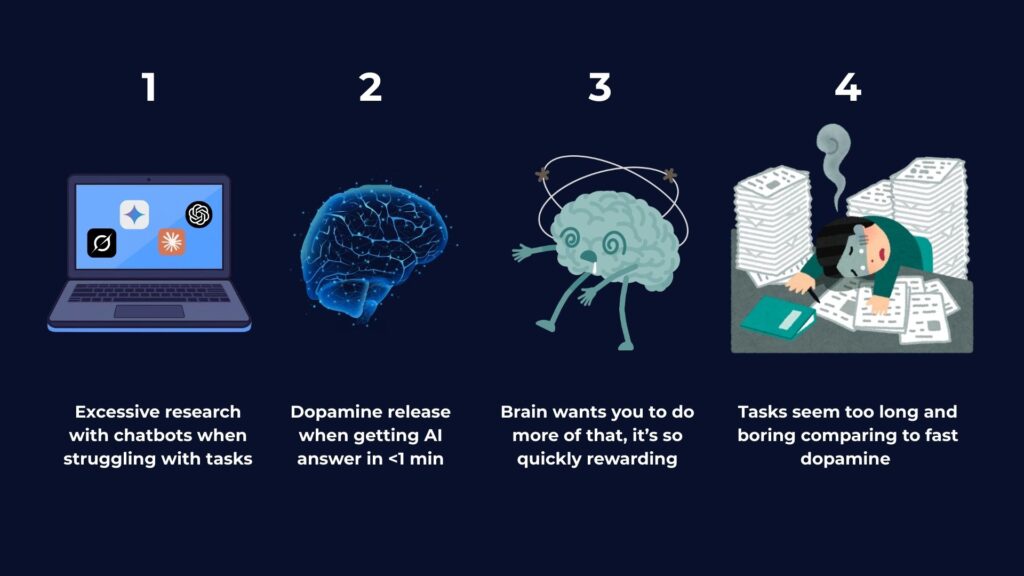
Why do you want to speak with AI longer than needed?
1. Every time you ask and wait for an answer, you get a small dopamine burst.
2. Now boom – you see an AI answer, your brain gets an instant reward. All that in just under 1 minute.
3. Your brain will encourage you to do more of AI chit-chatting – because it feels so good and rewarding.
4. The nervous system works on the simple rule: if something is pleasant, do more of that; if something is painful, avoid it as much as you can.
5. Now you have to do the real task. It seems long and complicated. Your reward for it will be sometime far away. Nowhere near this fast Chatbot satisfaction. So the brain hints against any “difficult” task.
The worst part is that AI procrastination feels different than other types. When we scroll instead of work, we know we procrastinate. With AI, we feel as if we have done the work. Though often we didn’t.
The reality check. AI is a powerful tool to solve some problems. It also has a big distraction and dependency potential.
People who used to procrastinate before (for any reason) – now procrastinate even more with AI. They’re more drained and overwhelmed. They feel that time is running too fast while progress is too slow.
Chronic procrastination is usually a problem of cognitive design, stress, or identity conflict. It’s solvable, I know for sure from my clients’ stories.
Just don’t let new distractions confuse you.
3 rules I use not to procrastinate with AI chatbots.
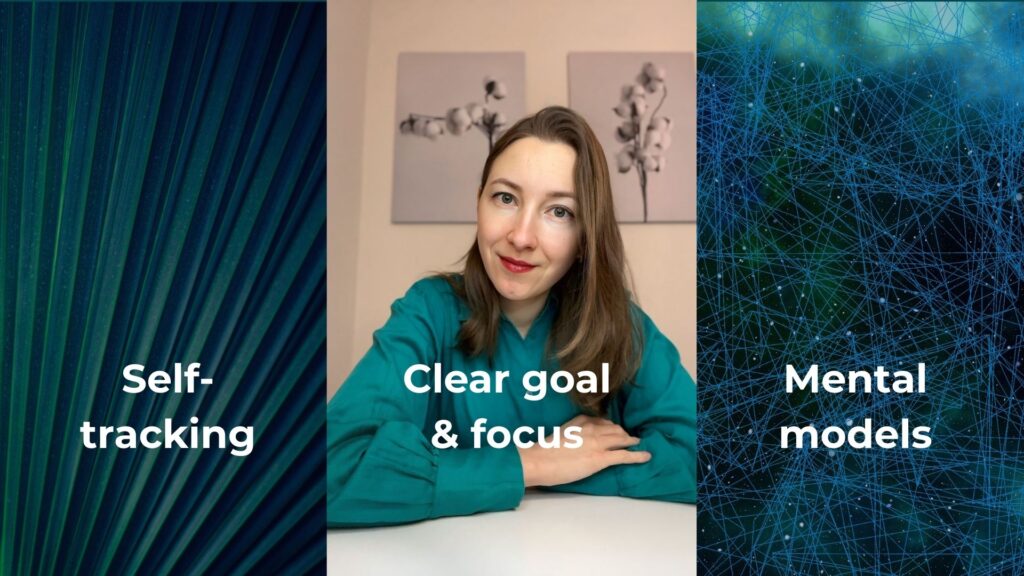
1. Track work honestly.
What is the best way to see if you’re AI-procrastinating? To do one thing I’ve been doing lately.
I track time when working on my tasks. And…I don’t count time spent on the “research”, if it didn’t bring any information I actually used in practice today or tomorrow. Full stop.
2. Have a clear goal and focus when chatting with AI.
Chatbots constantly drop leading questions to continue the conversation. This often distracts from our initial direction, leading to procrastination.
So, I try to keep a clear focus and stop myself from impulsively clicking “send.”
To achieve that, I’ve banned myself from writing messages shorter than two sentences. Why? I’ve noticed that short answers are usually more impulsive and distracting from the goal. Besides, by simply writing “yes” to a chatbot, you get a quick dopamine injection. I wrote about it earlier.
You also get worse responses.
3. Use smart mental models.
This rule helps me manage my curiosity. If I’m inclined to exaggerate on some topics I communicate with chatbots from other mental models.
For example, I imagine them to be a consultant whom I pay 300 euros per hour (name your price). It immediately helps me eliminate stupid questions and cut to the chase.
__________________________________________
If such rules don’t work, you might need to deal with the procrastination problem itself. If it’s affecting your productivity, mood, or self-respect, it’s wise to understand and remove the reason.
Chronic procrastination is usually a problem of cognitive design, stress, or identity conflict. It’s not a willpower thing. And it’s solvable.
If you’d like to save time – feel free to reach out to me.
I work a lot with professionals who suddenly begin procrastinating.