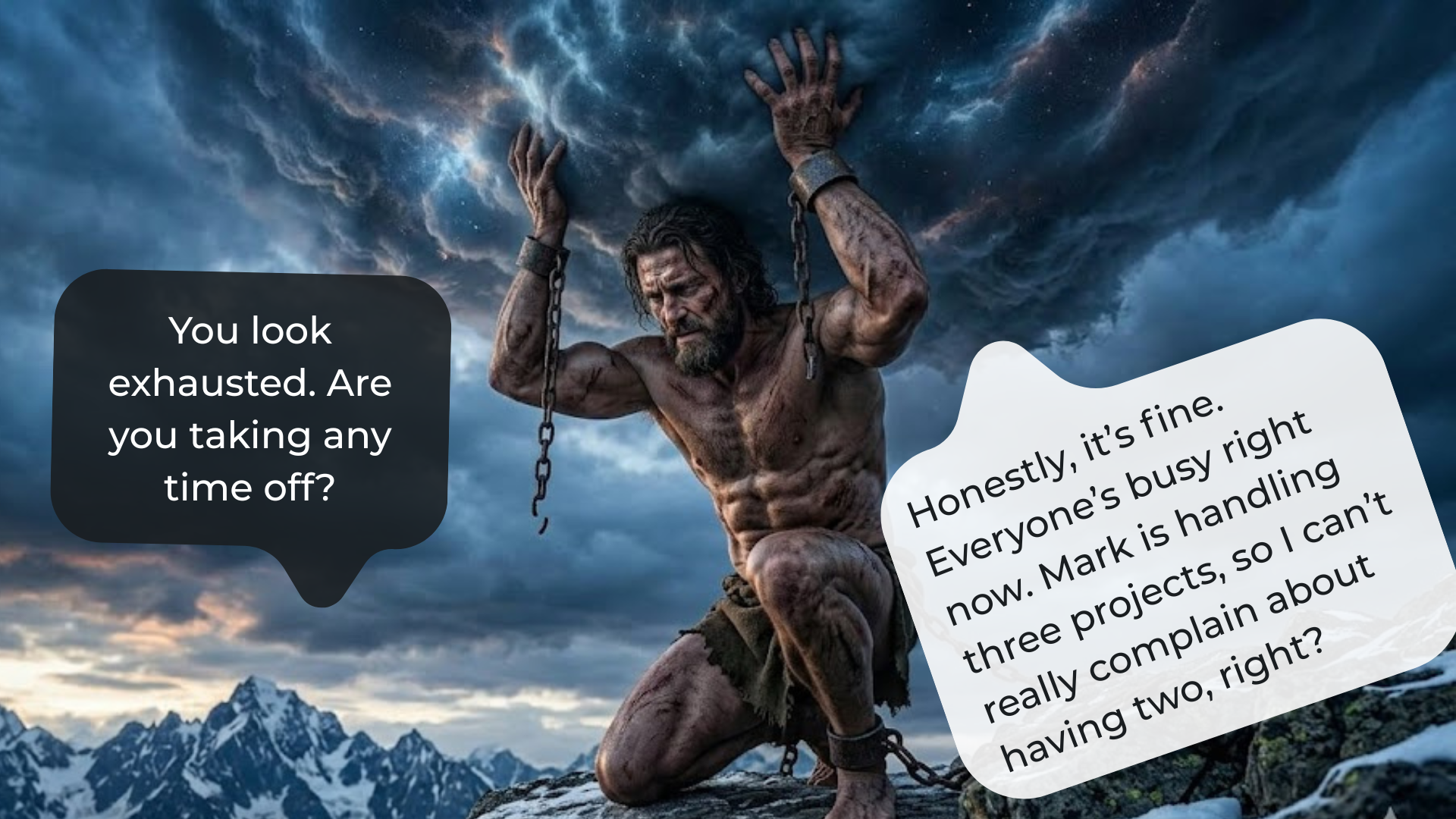
To rebuild your identity after burnout, you can practice radical honesty. By identifying specific actions you wish to stop doing and categorizing your response into one of three psychological states – numbness, overwhelm, or resistance – you can implement targeted micro-actions to reconnect with your authentic self and restore your healthy boundaries.
What does it mean to be a resilient person?
It means to effectively cope with obstacles and recover after seriously stressful events without physical and mental health damage. However, many people mistake resilience for endurance.
When you hear the word “resilience”, you likely imagine someone heroically holding the ceiling (aka Atlas).
Or Prometheus. That guy chained to a rock. He endures more than a normal person would – letting an eagle peck his liver daily and still showing up tomorrow ready to do his job.
In other words, some “yes-man” who can stand it all.
Bad news – that’s a proven way to burnout.
Often, people tolerate a little bit more each day until they find themself lost and exhausted “without obvious reason”. Until they can’t do anything without pushing themselves hard.


What is the connection between endurance and identity loss?
Endurance often forces people to say “yes” to things they strongly dislike, which eventually causes professional and personal burnout. Often, people tolerate a little bit more each day until they find themself lost and exhausted “without obvious reason”. This chronic suppression of true desires leads to identity crisis, where you feel numb, empty, or disconnected from who you are.
When you play the role of a “yes-man” for too long, your brain loses the ability to distinguish between your actual needs and external demands. In other words, our identity is both what we say “yes” to and what we say “no” to. Those are the psychological, or “ego”, boundaries that shape who we are.
Over time, this results not only in a loss of health and cognitive function, but to identity crisis.
It’s not only that you start hating your job (professional burnout), kids (caregiving burnout), or social media (digital burnout).
You also can’t say who you are as a person.
My clients often describe this as if they are “numb”, “empty” or “nobody” despite their actual skills and achievements.
Why is radical honesty the first step to recovery?
Radical honesty involves acknowledging the truth of your situation to yourself without immediate pressure to change others. It serves as a diagnostic tool to identify where you are betraying your own needs. That’s why radical honesty is the shortest way to restore your identity boundaries.
From today, start telling the truth to yourself.
No matter how hard it is.
Don’t shock other people with your honesty. That’s very much next-level.
Just be honest with yourself only.
The process begins with a single question:
What do I do every day that I sincerely want to stop doing, but keep pushing that thought away?
By answering this truthfully, you break the cycle of “pushing through” what’s not working and begin the process of rebuilding a sense of self based on your authentic needs.
Stay with it for a moment.
Based on my small research with working professionals aged 25 – 51, your answer might fall into one of three categories:
- I don’t know or can’t answer.
- I want to change everything or a lot of things at once.
- I can name 1-3 things I want to change in life right now.
Here is what you can do next, depending on your answer.
The Recovery Roadmap: Three Paths to Reconnection
| Your State | Possible Root Cause | Primary Sign | Next Step I Recommend |
| The Numb State | Chronic stress or full-scale burnout | “I don’t know what I want.” | Intentionally practice micro-choices. |
| The Overwhelmed State | Personal or professional crisis, possible chronic stress or beginning of burnout | “I want to change everything.” | Reflect on how you got there. |
| The Resistant State | Protective Fear | “I want to change 1-3 things, but…” | Record the excuses. |
Identifying your burnout state is the first step toward recovery. If you’re feeling numb inside or overwhelmed right now, you don’t have to navigate the path back to yourself alone.
I’ve helped dozens of clients move from “Prometheus-style” endurance back to authentic living. If you’re stuck in Option 1 or 2, a guided escape plan can cut your recovery time in half.
What should you do if you feel numb and “don’t know” what you want?
If you cannot identify what you want to stop doing, you are likely experiencing chronic stress. You’re already overwhelmed so your brain is incapable of generating “wants”. The second possibility is that you have been systematically taught that your needs don’t matter.
Both situations alienate you from your core identity.
The solution is to practice “micro-choices” to re-establish the brain’s connection to personal needs and desires.
- The Action: Start with tiny, low-stakes decisions.
- Examples: Ask yourself, “Is this chair comfortable?” or “Do I actually like the taste of coffee with milk? Or “Do I like this shirt?”
- What to know when practicing this: It might be harder than it sounds. You might feel stupid when you don’t know which coffee you really like. It’s fine. Just keep trying. That’s the best thing you can do for yourself right now.
How do you handle wanting to change “everything” at once?
Feeling the urge to change your entire life usually indicates a full-scale burnout or a deep personal crisis. To move forward, you must objectively trace the decisions that led you to this breaking point without resorting to self-blame.
- The Action: Perform an “audit” of your past choices like a biologist observing a specimen.
- Examples: How did I get to this point? What actions and decisions brought me there? Where have I betrayed myself?
- What to know when practicing this: Identify patterns where you betrayed your own boundaries. Understanding the “entrance” to your current situation is the only way to find the “exit” and prevent repeating the cycle.
How can you overcome resistance to specific life changes?
If you can name 1–3 specific things you want to change but feel stuck, you are experiencing “protective resistance” from your psyche. Instead of trying to force a breakthrough, you should document the voices and excuses preventing your progress. Listen first.
- The Action: Spend one week writing down every “why not” or excuse that enters your mind.
- Examples: One part of you says: “I want to try a new career path”. Another part of you answers: “It’s too late. I can’t start over, I’m too old for that”. You just record those words.
- What to know when practicing this: Don’t censor or criticize yourself. Act as a neutral observer. By recording thoughts like “I’m too old to start over,” you externalize the fear, which reduces its power and allows you to see your internal conflicts clearly.
Key Definitions for Self-Recovery
- Identity Diffusion: A state where an individual lacks a firm sense of self and finds it difficult to make choices or commit to a direction. It usually feels as genuinely not understanding who you are as a person and/or as lack of inner support.
- Radical Honesty: The practice of being completely transparent with oneself about feelings, desires, and dislikes, even when they contradict external expectations. This is not an esoteric concept, this practice can be traced down to Cognitive Behavioral therapeutic approaches of the third wave.
- Protective Resistance: A psychological defense mechanism that creates excuses to prevent change, aiming to keep the individual in a “safe” (even if unhappy) status quo. Some examples include rationalization (finding logical but false explanations), projection (projecting one’s feelings or thoughts inside other people’ minds as if these were theirs), procrastination (not doing planned tasks) etc.
Frequently Asked Questions (FAQ)
How do I know if I’m burned out or just tired?
Tiredness is resolved by proper sleep and rest. Burnout is a deeper exhaustion that changes your identity. These changes don’t disappear after sleep or vacation. The typical features of burnout are emotional exhaustion, cynicism, a sense of emptiness, emotional detachment and a lack of personal accomplishment.
Is it selfish to focus on what I want?
No. Reclaiming your “want” is the only way to stop the cycle of burnout. Without a clear sense of self, you eventually become ineffective and resentful in your roles as a professional, parent, or partner. Besides, if you don’t take care of your own needs, this means you put the burden of it on someone else. So always start from covering your essential needs.
How long does it take to rebuild an identity?
Identity is a lifelong process, not a destination. The initial “fog” of burnout can lift in months through proper rest and workload correction (this step is not covered in this particular article). However, rebuilding a confident sense of self and healthy boundaries is a gradual practice of making consistent, authentic choices. From what I see in my clients, it might take a couple of years. So if your journey feels a bit slow, this might be okay.
Reclaim Your Fire
If you can relate to feeling like Prometheus (chained to a rock and enduring the daily grind at the cost of your soul) it’s time for an escape plan. Message me today for a free discovery call.