Main points:
- There are 8 types of a demanding client who require professionals to invest additional resources to get the job done.
- Difficult clients can negatively affect emotional reserves and cognitive abilities, deplete a professional’s core resources, and harm health, with a high potential for burnout.
- In 2026, clients arrive more prepared with AI, which can threaten professional confidence. Difficult clients can misuse AI to create an unreasonable scope of work.
- I suggest an 8-step framework to analyze challenging clients. It helps to lower stress levels and create a better strategy to cope.
Nobody wants demanding, unsatisfied, picky clients. Those you can’t stop thinking about in the middle of the night. Are they really difficult, or is it your discomfort speaking?
Here is how I tell the difference after 8.5 years of consulting and coaching professionals. Someone could call half my clients “difficult”. Still, I’ve learned a valuable lesson from each of them.
Let’s start with an uncomfortable truth. The majority of clients seem “difficult” until you understand what drives their behaviour and how to handle the tension.
Often, we become more confident with practice. However, your professional level might be high, while your skills to hold the tension didn’t get the same attention.
What is a difficult or demanding client?
A difficult client is a client who behaves in a way that requires professionals to use significantly more resources to complete the job. The resources that a professional invests may not pay off.
8 types of difficult / demanding clients ?
| Type of difficulty | Unreasonable client behavior and customer incivility examples | |
| 1 | Unwanted emotional communication style | The client is rude, devaluing, hostile, insulting, anxious, unreasonable, demanding special treatment, overly suspicious, dramatic, intense. |
| 2 | Crossing the boundaries | Excessive amount of communication, unrealistic expectations about speed, quality, work scope, or availability of professionals (e.g., 24/7). Clients ask for add-ons or not agreed changes after the task is done, gaslight about the agreements, don’t pay on time or as discussed, challenge your professional abilities or work results unfairly. |
| 3 | Responsibility issues. Can’t make decisions or stick to them | Constantly change their mind over core demands or suggest new adjustments, refuse to make decisions inside their responsibility zone, ping-pong responsibility between people so you can never reach the decision maker, postpone signing legal documents, etc. |
| 4 | Lack knowledge or understanding | Present with unrealistic expectations and unwilling to correct them after listening to an expert, don’t understand what they want, don’t understand field constraints (e.g. insists on creating an AI project out of currently possible context window limits). |
| 5 | Financially challenging | Endlessly negotiate prices, demand discounts, expect more work for the same payment, refuse to pay or impose unfavorable payment conditions. |
| 6 | Physically aggressive, harmful | Violate social norms (including legal and cultural norms), actively harm (to your property, reputation, dignity), threaten, blackmail, file unfair legal or semi-legal complaints, stalk. |
| 7 | Personally triggering | What they do or how they present makes you feel small, insignificant, unsafe, like a fraud or imposter, unappreciated. You feel envy or want to compete with them/defeat them. They remind you of someone you feel strongly negative about – (e.g. your ex, your strict teacher, your controlling parent, etc). |
| 8 | Abusing AI-mediated resources | Use AI – To generate demands, arguments, or responses; – To do their part of responsibilities, which results in low quality, safety issues, or excessive amounts of communication; – To challenge our professional decisions and judgement; – To analyze your behaviour (beware, they say clients are feeding everything you give them with AI); – To negotiate the terms or price, or challenge you, like “prove I should pay if one can do it for free with AI”. |
How does a difficult or demanding client affect you and your resources?
Mistreatment from clients significantly affects you in at least four parameters:
- Emotion – you have to do extra mental work to process clients’ and your emotions, and still act professionally.
- Cognition – it decreases your logical thinking, flexibility, and creativity; it negatively affects self-esteem and confidence.
- Resources – you need to put more effort, time, and personal resources to manage difficult clients and preserve your health.
- Overall health and energy levels – dealing with difficult clients can make your body constantly stressed and fatigued; sleep and recovery – worse.
In some fields, 76% of employees experience harmful client behaviour (mistreatment) at least once a month. Workplace aggression can cost companies from $692 billion to $1.97 trillion annually (2021 study).
If not managed properly, stress from difficult clients can kill the core motivation to provide good service. Fujii 2026
So, frequent communication with difficult clients can cause burnout, physical and emotional exhaustion, and other chronic stress outcomes (health issues, relationship conflict, premature aging, etc).
Demanding client 2026: what is different now with AI?
In 2026, clients arrive with an AI-generated illusion of their own competence in the field.
Our first automatic reaction can be defensive or aggressive, because they are trying to compete with us in our territory.
When we perceive a situation as a threat, we fall into a stressed state. In such a state, our logical and strategic thinking becomes biologically impaired. That’s why solving difficult clients requires controlling our stress.
Though AI-mediated communication presents a new type of difficult clients, they actually are just another manifestation of the same global problems:
- Enshittification of the quality of goods and services and low trust among customers.
- Some clients are just vermin as humans. “The client is always right” can be a dangerous idea. There should be boundaries and relevant support for both sides of communication.
Your clients are still driven by the same psychological needs as before. To manage them, you still need to manage your stress and think clearly.
My 9-step framework for lowering stress with a demanding client (it takes under 15 minutes; you can follow it right now):
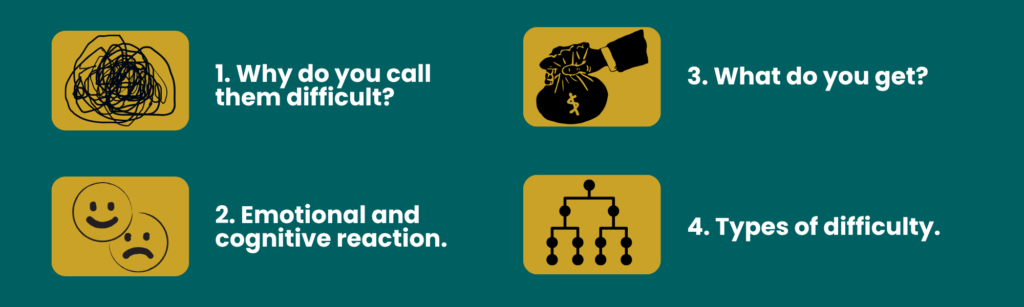
1. Why do you call them difficult or demanding? Write in your own words.
Example: “The client is putting pressure on me. I never know how to respond.”
2. Write down your response to a difficult client – what’s in your body, what emotions do they bring up in you, or what they make you think.
Example:
- Body: can’t fall asleep, can’t stop thinking about that client, clenched jaw, raised shoulders, sweaty hands, a trembling voice.
- Emotions: anxiety, shame, resentment, injustice.
- Thoughts: I’m professionally worseless; I can’t stand up for myself.
3. What do you get from that client?
Specify the exact fee and any intangible goodies that you’re receiving with this particular work.
4. Which type(s) of difficulty from the table above do they represent?
Example:
Emotionally difficult (rude, yelling, belittling), crossing the boundaries (attacks agreement about the work scope), and personally triggering (reminds me of my abusive ex-boss).
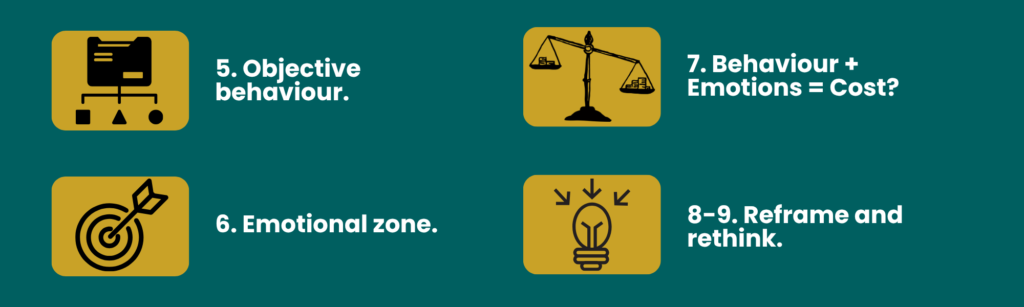
5. Check their objective behaviour markers:
- Do they pay as discussed and on time?
- Do they cooperate – provide info, talk about problems they have, follow your recommendations, provide feedback?
- Do they fulfill their obligations and accept their part of responsibility?
6. Check your emotions when dealing with this client.
I divide emotional responses into 2 groups: a no-go zone and opportunity zone. It’s best if you set your own no-go emotions based on your personal situation, current limitations, and professional field.
– No-go/skip zone: If you feel disgust, disrespect, or horror, you’d better avoid this work.
Here is why:
- If there is no mutual respect at a basic level, we won’t get a good result.
- Disgust usually means that something violates your core values. For example, I wouldn’t work with people in some industries because I don’t support what they do to society.
- Horror is an intense emotion. It indicates that something is too frightening to be fully processed by the mind.This feeling usually arises near people with dangerous personal pathologies – they might be manipulative, not empathetic, lying, cheating, violent, etc.
Opportunity zone: If you feel shame, imposter syndrome, irritation, anxiety, tension, or boredom – that might still be an opportunity.
Shame – some people make you feel small and pitiful just with their presence. That’s definitely not a pleasant experience; however, in some industries, you can’t avoid these people. Moreover, they can be your best clients.
Imposter syndrome – the prevalence of imposter syndrome was reported as 62% (2025 data). My point is that many people experience imposter syndrome, especially when under stress, in high-competition jobs (technology, finance, marketing) and when leveling up (or getting a promotion). So feeling like an imposter shouldn’t have a major vote in your decision.
Irritation, anxiety, and tension are typical words for how people describe stress response. Not every stress is bad. Sometimes stress may actually mean that you saw a challenge and your body is prepared to act.
7. Behaviour + Emotions = Cost?
Look at everything you’ve written. Considering the client’s objective behaviour, emotions, and stress level you feel around them, and what you gain by working with them, complete your equation.
8. Reframe your “demanding client” according to the framework.
Example: The client asks to increase the work scope, which violates our legal agreement. They do it using verbal aggression. This reminds me of my ex-boss, whom I couldn’t get over. That is why, when I deal with this client, I feel resentment and injustice. The client’s financial contribution is sufficient, and I will use their project in my portfolio.
9. Draw the line – what can be done differently by you and where you should protect your boundaries.
Example: I’ll present my arguments more confidently and calmly. I’ll listen to understand what stands behind the client’s dissatisfaction. I’ll say directly which communication isn’t tolerated.
This framework lowers your stress because it puts control back in your hands.

As a stress resilience coach, I help people stay calm and confident in stressful situations so they don’t lose great opportunities.
If you’re interested in solving the root cause of your stress – sign up for a free call or resilience diagnostics to discuss your situation in person.
Sign up here Google Calendar
Read more about Diagnostic of Stress and Resilience.